How to count money fast
Counting money quickly is mostly about setup, not finger speed. Sort the bills, face them the same way, count in groups you can check, and write each total down as you go. Here’s the method, step by step.
Updated · Vito Software, maker of Simple Voice Calculator
On this page
Before you count: sort and face
Most counting mistakes happen before the counting starts, in a messy pile. Spend a minute on setup:
- Clear a flat surface. Nothing else on it: no receipts, no phone, no coffee.
- Sort by denomination. One stack each of 100s, 50s, 20s, 10s, 5s and 1s, and a separate pile for coins.
- Face the bills. Turn every bill the same way up, portrait side facing you. Faced bills are faster to flick through, and a stuck pair, a torn note or a bill in the wrong stack stands out.
- Count the biggest bills first. If you get interrupted, the expensive part is already done and written down.
How to count money as a cashier
Hold the stack in one hand and peel bills off with the thumb of the other, moving each one to a new pile. Then count one of two ways:
Count the bills, then multiply
Count "1, 2, 3…" and multiply at the end: 37 twenties is $740. Counting from 1 upward is easier than adding 20 at a time, and it's harder to lose your place, so it's the more reliable method for a big stack.
Count the value as you go
Say the running amount: "20, 40, 60, 80, 100…" This is quick for a few bills, like change in a till, but it's easy to lose track past a hundred or so.
Group and cross
Whichever way you count, put the bills down in groups of 10 or 25, each group crossed over the one below it. If you lose count, you only recount the last group, not the whole stack. Then count every stack a second time. If the two counts disagree, count a third time.
Bank straps and coin rolls
In the US, a bank strap holds 100 bills of one denomination. The strap color tells you the value at a glance:
| Bill | Strap color | 100 bills |
|---|---|---|
| $1 | Blue | $100 |
| $2 | Green | $200 |
| $5 | Red | $500 |
| $10 | Yellow | $1,000 |
| $20 | Violet | $2,000 |
| $50 | Brown | $5,000 |
| $100 | Mustard | $10,000 |
Standard coin rolls work the same way. You count the rolls and multiply, without opening them:
| Coin | Coins per roll | Roll value |
|---|---|---|
| Pennies | 50 | $0.50 |
| Nickels | 40 | $2.00 |
| Dimes | 50 | $5.00 |
| Quarters | 40 | $10.00 |
A strap or roll from someone else is worth checking before you rely on it: count one at random every so often.
How to count a cash drawer
At the end of a shift, the goal is to find out whether the cash matches what the register says it should be:
- Count each denomination and write it down. Use a count sheet, or a column on paper: 4 × $100, 2 × $50, 37 × $20, and so on, then the coins.
- Add up the total. Multiply each count by its value and add the lines.
- Subtract the starting cash. The float, or bank, you started the shift with stays in the drawer. What's left is the shift's cash takings.
- Compare with the register report. A difference means the drawer is over or short. Recount before you record it.
Writing the count of each denomination down, not just the total, is what makes a recount quick. You can check one line instead of the whole drawer.
Adding it all up by voice
The adding up is where the last mistakes creep in, usually while you're switching between bills and calculator keys. With a voice calculator, your hands stay on the money. Here's a full drawer in Simple Voice Calculator, said in one go:
"100 times 4 plus 50 times 2 plus 20 times 37 plus 10 times 12 plus 5 times 9 plus 23 plus 0.25 times 31 plus 0.10 times 18 plus 0.05 times 12 plus 0.47 minus 150"
That's $1,428 in bills, $10.62 in coins, minus a $150 float: 1,288.62. Multiplication is done before addition, so each "times" line is worked out first, the way you'd want. You don't need to say "dollars", and it's ignored if you do.
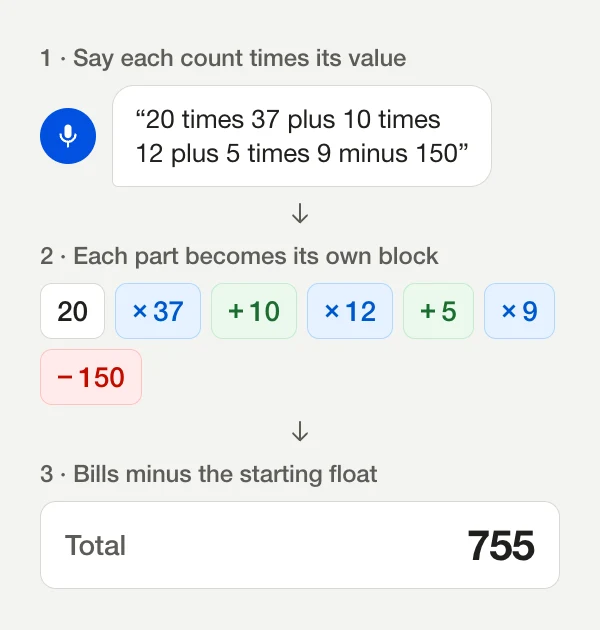
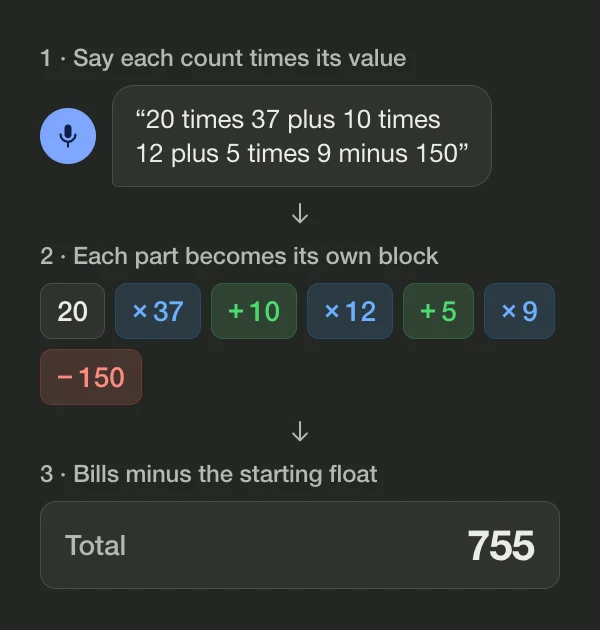
Each part appears on screen as its own block, so you can check the counts against your sheet. If one was misheard, tap its block and fix it instead of starting over. With Pro, the total is saved to History, which helps when a manager asks about yesterday's drawer. The full list of phrases shows how to say decimals and corrections.
Mistakes to watch for
- Stuck bills. New bills cling together. Flick each one, or rub the corner, before you count it.
- A bill in the wrong stack. A 10 among the 20s costs you 10 dollars. Facing the bills first makes it stand out.
- Interruptions. Write the count down before you answer anyone. A half-counted stack is the one that gets counted twice.
- Trusting one count. Two matching counts are the minimum for anything that leaves your hands.
Questions people ask
What is the fastest way to count money by hand?
Sort the bills by denomination, face them the same way, count the number of bills in each stack in groups of 10 or 25, and multiply at the end. Then count each stack a second time.
How many bills are in a bank strap?
100 bills of one denomination. A strap of $20 bills holds $2,000, and the strap color shows the value: violet for $20s, mustard for $100s.
How much money is in a roll of quarters?
$10: 40 quarters. A roll of dimes holds $5 (50 dimes), nickels $2 (40 nickels) and pennies 50 cents (50 pennies).
How do you count a cash drawer?
Count each denomination and write the counts down, add up the total, subtract the starting cash (the float), and compare what’s left with the register report.
Can a calculator app help count money?
Yes. With a voice calculator you can say “20 times 37 plus 10 times 12…” while your hands stay on the bills, and check each count on screen before you write the total down.

Simple Voice Calculator
for iPhone.
Free on the App Store, with no ads. Works on iPhone, iPad and Apple Watch. Rated 4.6 out of 5 by more than 200 people.
More guides
Try and learn
- Online voice calculatorTry voice math in your browser, free.
- What to sayEvery phrase the app understands.
- Talking calculatorSpeak it in, hear the total back.
- Siri as a calculatorWhat Siri can do, and where it stops.
- Action button ideas12 useful things to put on it.
- What is 10-key?Ten-key typing, speed and practice.
Use it for